Iron Dextran Production
Iron Dextran Substrate and IV Iron Carbohydrate Precursors
Iron Dextran Substrate
Low-molecular-weight dextran is used as the carbohydrate backbone in iron dextran complexes, where it stabilizes ferric oxyhydroxide for parenteral iron products used in iron-deficiency anemia.
A narrow molecular-weight distribution is a key advantage in this application. Broad, acid-hydrolyzed dextran fractions can contain high-MW species associated with higher allergenic risk, as well as very-low-MW fractions that may create unwanted degradation products. These tails often require additional fractionation before iron complexation.
Primogene’s well-defined low-MW dextran provides a controlled substrate for reproducible iron dextran production, with applications in both veterinary iron dextran for piglet supplementation and human parenteral iron for iron-deficiency anemia.
Carbohydrate Precursor for Parenteral Iron Complexes
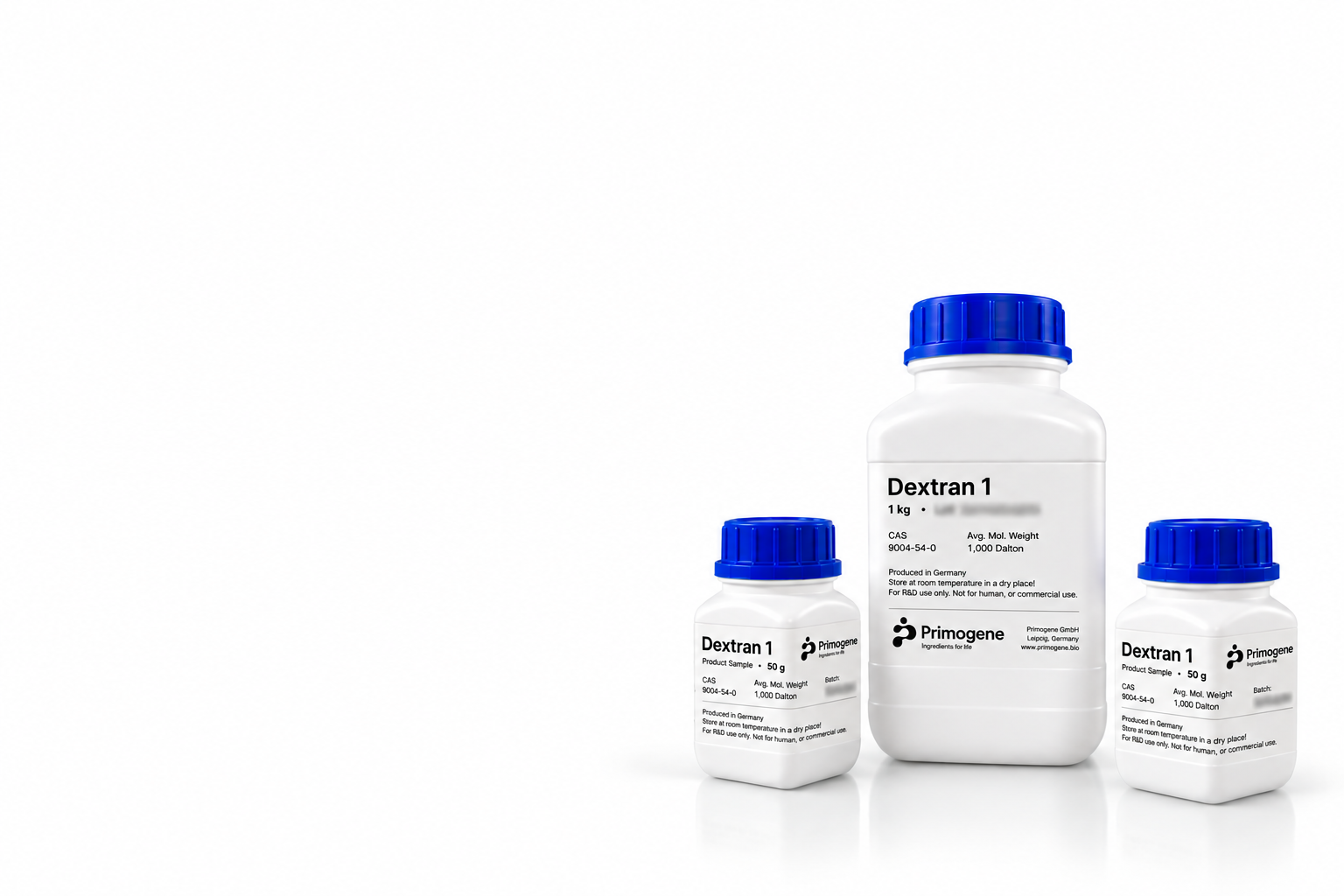
Very low-molecular-weight dextran can serve as a carbohydrate precursor for modern IV iron complexes. In ferric derisomaltose, also known as iron isomaltoside 1000, the carbohydrate component is based on a defined ~1 kDa α-(1→6)-linked glucose oligomer, derived from low-MW dextran material, for example by hydrogenation.
The ~1 kDa linear carbohydrate helps support both low immunogenicity and low viscosity, enabling high iron loading in a modest injection volume. Primogene’s narrow, well-defined and fully linear Dextran 1 provides a controlled starting material for reproducible production of carbohydrate-based IV iron complexes.